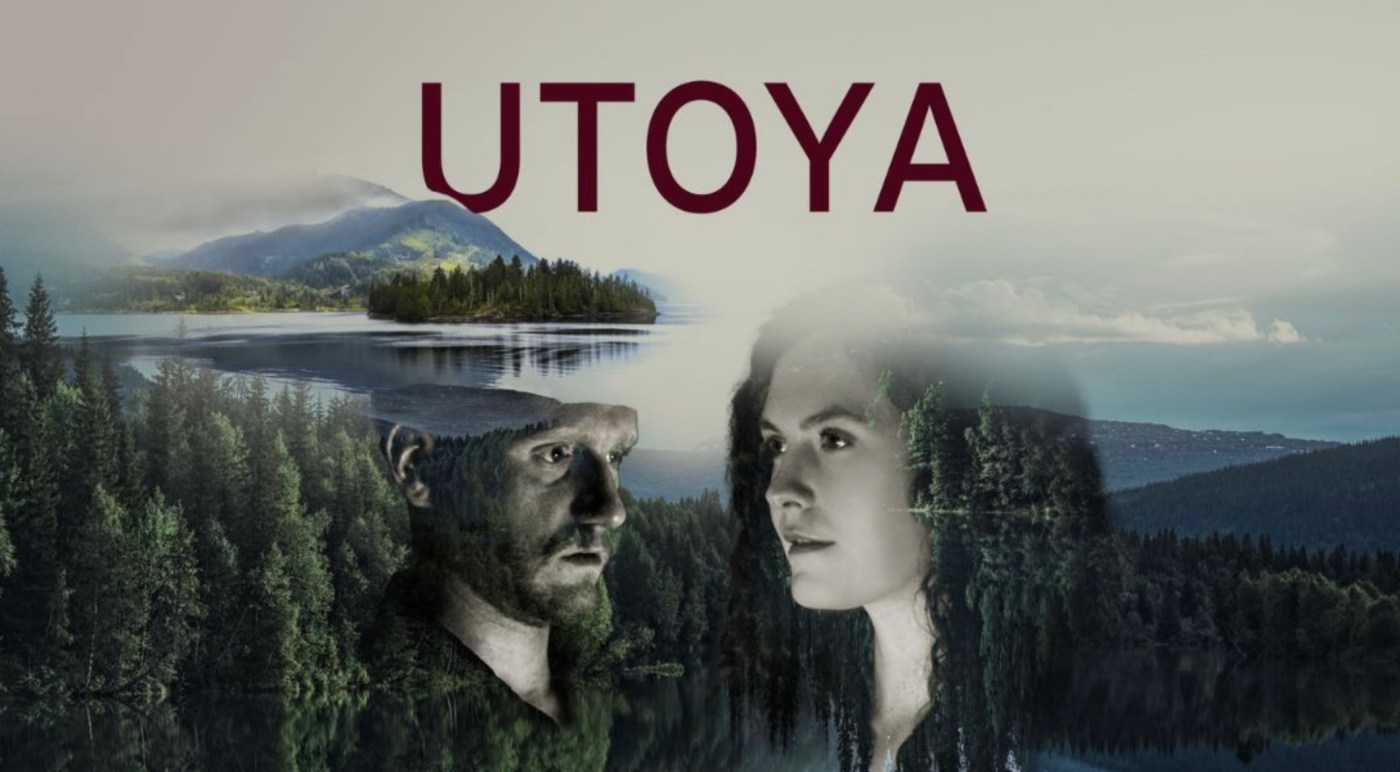
Thursday, 15th August 2024 at Arcola Theatre, London
⭐️⭐️⭐️⭐️⭐️
Reviewer: Emma Dorfman
It must be wishful thinking, but I consistently hope against hope that there will be a day when far-right, Neo-Nazi terrorism will cease to be relevant. And even though it depicts events that occurred nearly 15 years ago, against the backdrop of the recent far riot riots across the UK- riots that bear direct threats against people of colour, migrants, and other marked peoples- Edoardo Erba’s Utoya feels more than urgent and necessary.

If you were to ask a pool of people in the area surrounding the community I grew up in, I am almost certain you would get very few, if any at all, who have heard of Norway’s deadliest attack since World War II– a bombing and mass shooting that killed a total of 77 people in Oslo and on the island of Utoya, which is just 38 kilometers northwest of the city. It is difficult to push past this point: 77 lives expired in just a few hours, and yet, I am only just now hearing about it? Already, it says something about the inherent violence that oozes and seeps across communities, which is an ever-so-necessary story to tell now.
Erba’s razor-sharp script does the story justice, and Sarah Stacey’s direction provides the perfect mix of crystal clear and mildly disorienting storytelling. Actors Kate Reid and Marco Young (who also wrote the seamless translation from the piece’s original Italian) make the production sear and sizzle, holding moments dramatic beyond comprehension and comedic beyond belief.
The play centres around 3 pairs of people, who share three different perspectives of the event: there’s an upper-class married couple, who have decided to send their teenage daughter to the camp on Utoya, there are two patrol officers who are in charge of the area near the island, and finally, a brother and sister who are unknowingly the perpetrator’s neighbours. As we shift scenes, we move from one perspective to the next, charting the linear sequence of events from all three perspectives. In scene changes, Jamie Lu’s sound design and Stacey’s direction are harmonious.

Like a volcano on the verge of erupting, the sound compositions make the audience feel the full weight of what is about to happen. The sonic tension never releases, rising to meet set (Caitlin Mawhinney) and lighting (Catja Hamilton) in one (literally) seismic stage moment (no spoilers here, but it was so subtle, yet so magical). The actors skirt the perimeter of the stage, lined with bright strip lighting, slowly and with purpose.
They use this as an opportunity to shift and morph into their next character with little more than subtle changes in body language, mannerisms, vocal cadence, and rhythm. Young, in one instance, is a sexist slimy patrol manager. In the next, he’s an immature 30-year-old who basically lives at the local pub and is failing to launch. Likewise, Reid is a riot as Marlin, an uppity wife and mother who acts as if she has two degrees of separation between anyone and everyone (in reality, it’s more like five-seven). But in an instant, she transforms into Inge, a more measured, responsible older sister with an illness she knows will mean her end.
Within the scenes of themselves are moments full of gravity and humour, the latter of which you wouldn’t expect based on the show’s subject matter. Comedic relief comes mostly from married couple Gunnar and Marlin, who, for instance, are initially discussing “the Norweigian.” Marlin reads a paper akin to a eugenic report of the shape of their faces, their general nature, and their ability to “catch birds in midair.” It’s actually about the Norweigian Forest cat, but it aptly sets the tone for the play, injecting an unexpected twist into what was assumed before as something much more sinister. This is a testament to Erba’s writing and Young’s whip-smart translation.

In addition to staying faithful to the show’s real-life events, the playwright has several interesting takeaways to chew on during the train ride home. For instance, Marlin’s criticism on her husband’s steadfast belief in socialism: “Faith is the worst sickness a human could have.” And then there’s the patrol manager’s response (or lack thereof) to the mass shooting on the island. He’s apolitical, he reminds his colleague. But then, I wonder, what does he have to stand for? And is this the reason his first instinct was to do absolutely nothing when duty called?
There were other moments within the script that certainly proved challenging, and it wasn’t just those that dealt with the conversations around, and aftermath of, the events. Some of the more comedic reveals (no spoiler), I anticipate, will rub certain audiences the wrong way. I, for one, appreciated some levity amid the incomprehensible tragedy. And I rate the playwright even more highly for being daring enough to take the risk.
Utoya is at Arcola Theatre until August 31st – more information and tickets can be found here.
 Always Time For Theatre