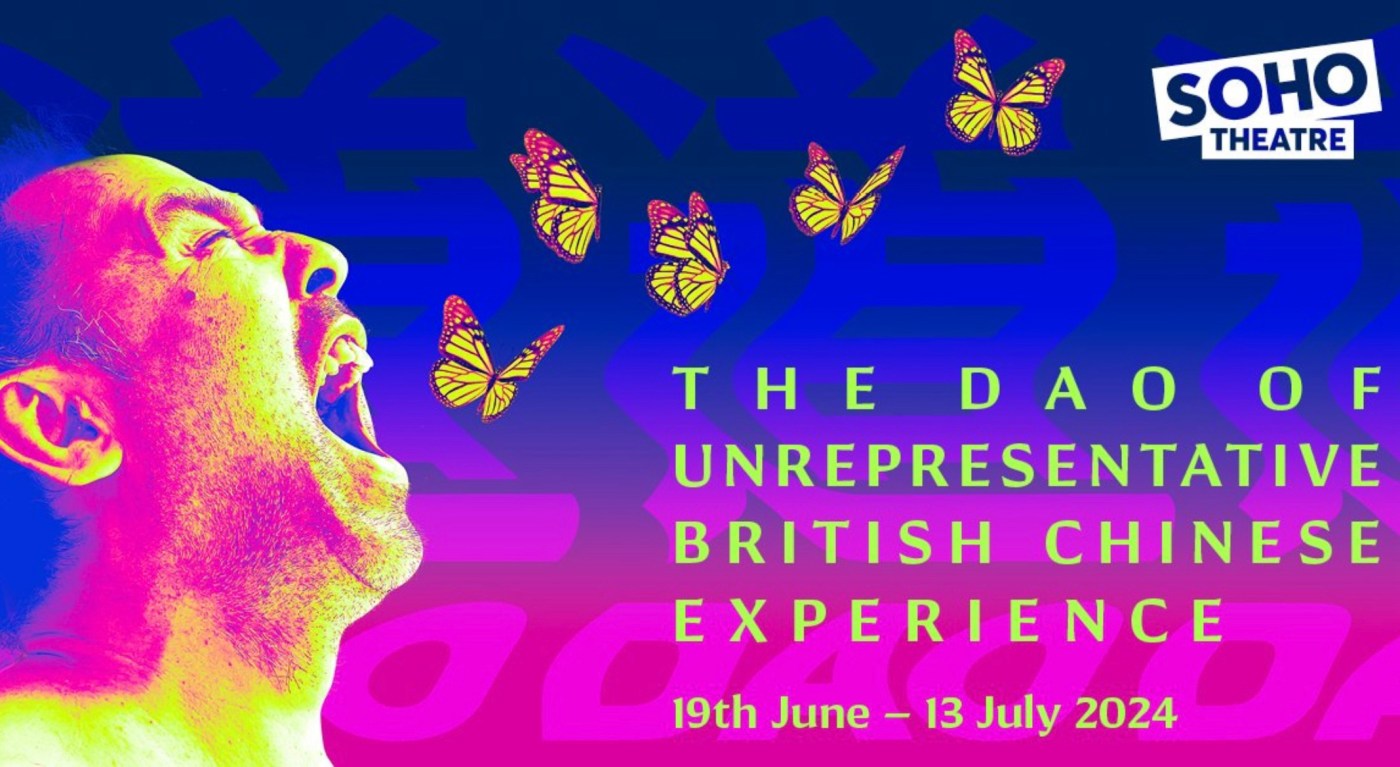
Friday, 21st June 2024 at Soho Theatre
⭐️⭐️⭐️
Reviewer: Emma Dorfman
A postdramatic gig theatre fever dream – in which the audience is invited to witness a fraught navigation through a paradoxical mix of identities – The Dao of Unrepresentative British Chinese Experience is, what I would consider to be, High Art. Heady and intellectual, the production uses the philosophical concept of “Dao” as a framework for a highly psychedelic, Alice in Wonderland-esque foray into the British-Chinese experience.
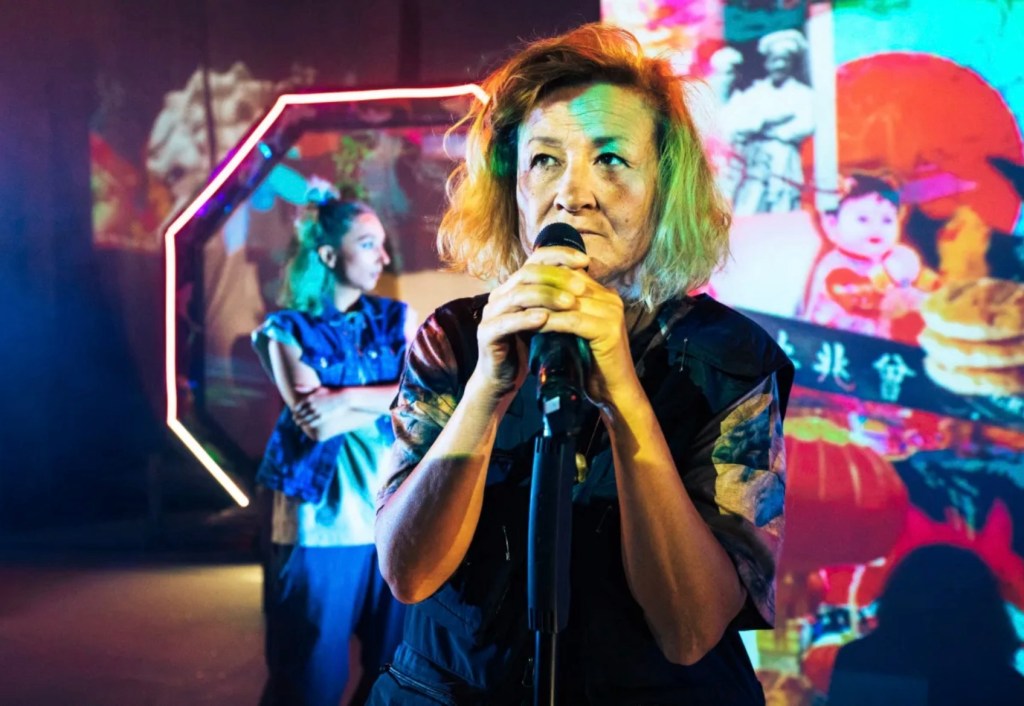
The multi-talented ensemble (Daniel York Loh, also the writer, Melody Chikakane Brown, and Aruhan Galieva) holds the audience as best they can amidst what is undoubtedly a hard-to-follow, highly cerebral narrative. The seamless integration of video and projection elements (courtesy of Erin Guan) and gig theatre interruptions (or, provocations) are welcome respites when Loh’s text gets just a bit too rich.
We begin with Loh onstage, interrogating the meaning of story– a beginning that primes the audience well for what is about to unfold: “What is story? Does it need a beginning, middle, and end?” A big question and a big opening moment, and it proves that I would happily watch Loh read a phonebook for an hour and a half if that was on the menu. In other words, he is incredibly compelling to watch, and his commitment to the text is evident in his performance. Whilst onstage, I get the feeling that not a single word is superfluous, and Loh says precisely what he means.
As we are introduced to the other ensemble members, this initial concept of story – which expands into the concept of “dao,” and, more specifically, a multiplicity of “daos” – is complicated further. Using dao as a dramaturgical framework, the production evolves into an episodic hodgepodge of what it means to be both British and Chinese. Ultimately, the result is a story that can’t help itself from jumping around.
Our central character, Cloud, for instance, consults with Master Obscure, a mystic and master of all things “dao;” another character, that remains nameless, is taunted on the playground for that non-British half of themselves, finding themselves amid a barrage of ESEA slurs. Father McNamara appears as a shadowy man behind the curtain– a device for the little voice inside Cloud’s head that insists they are making up their own dim sum outings on Sundays with Apa: they’re not really that Chinese. Finally, Cloud encounters Opaque, Master Obscure’s sibling in something of an Eden where there is a lake full of boba with the mythic Pangu buried at the bottom. It is, as the programme promises, “psychedelic.” But is it too heady and intellectual for the audience to follow without a bit of reading beforehand?
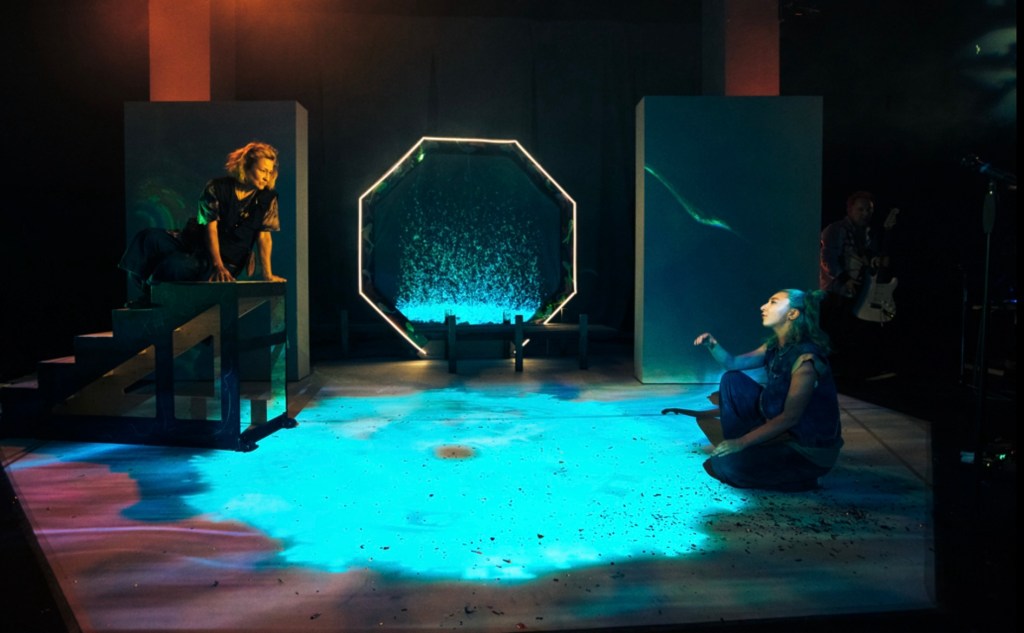
To counteract this, intricate video and production design alongside musical performances provide relief from the admittedly hard-to-grasp concept of dao. When Cloud reveals a private struggle for instance, the video projected behind shows a view into the world through Cloud’s eyes– something of a blurry, urban stew of traffic lights and busy streets. Without this design element, it would be impossible to transport to this world and into the previously-mentioned Eden and London’s Chinatown and the rural playground where our unnamed character is bullied and verbally abused. This ability to quickly shift the environment keeps the audience alert and on its toes.
Of course, this is also a piece of gig theatre, and it wouldn’t be a gig without a few musical interludes, would it? Here, some songs are musically stronger than others both in terms of melody and lyrics. The opening song, in which the ensemble sings, “Lock me up/Send me back/East and West/Stake their claim,” is a defiant, Sex Pistols-esque tune that embodies the defiance of the punk genre whilst putting it the show’s unique context.
As the numbers progress, they become more and more metatheatrical, almost to the point where it grates on the audience. To be fair, the production is strongly aware of its own metatheatricality: at one point, Cloud ushers the house lights to go up completely, even taking a seat in the audience and directly pointing out to character Sargeant Harris that this is a work of theatre.
In the end, The Dao of Unrepresentative British Chinese Experience, devolves into an endless, circuitous questioning of itself. I suppose this is the very point: there is no definitive account of British Chinese experience. It just can’t be done. Ultimately, the production offers much food for thought. I only wish I could properly remember the journey that the show took me on.
The Dao of Unrepresentative British Chinese Experience is at Soho Theatre until July 13th 2024 – more information and tickets can be found here.
 Always Time For Theatre
Leave a comment