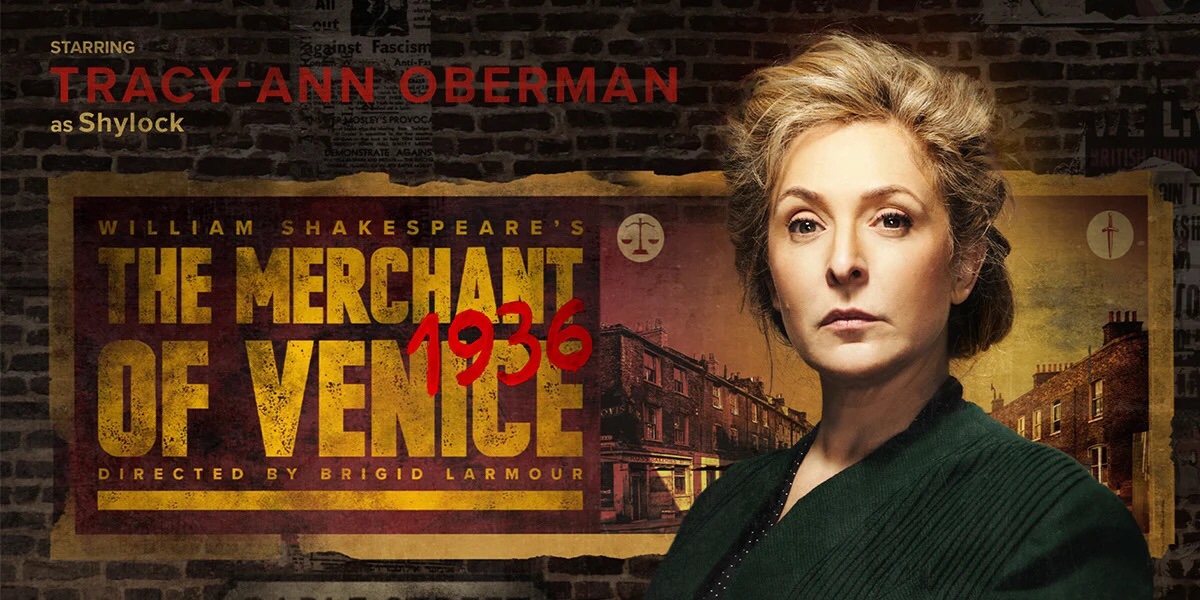
Tuesday, 14th November 2023 at York Theatre Royal.
⭐️⭐️⭐️⭐️⭐️
Mild spoilers ahead…
The Merchant of Venice: comedy? Romance? So some say. To me it’s always been a tragedy of powerlessness which wrongfully sidelines its most compelling character, so I am a huge fan of this latest adaptation which restructures and reframes the story to place Shylock at the very centre and keeps them there. Not only this, but adaptors Brigid Larmour (who also directs) and Tracy-Ann Oberman (who also stars) have cast a female Shylock in a 1936 London setting – and every shift has something valid and valuable to offer. In fact, rarely has Shakespeare’s work been adapted so well or so meaningfully as this.

The tale in its original form moves between two love stories and a darker thread about man’s inhumanity to man. More gripping by far though is the latter: a controversial matter of a bond agreed between Bassanio’s friend Antonio – a Christian – and a moneylender named Shylock – a Jew. When Antonio cannot repay the debt, the forfeit is a high price indeed, and the messaging around conflict, prejudice and resolution is the source of considerable ambiguity, particularly when taking into account the widespread antisemitic feeling at the time of writing – and a feeling also very prominent in the updated setting of this production.
Costumes by Liz Cooke announce the era quickly: we are in 1936 London and increasingly, the streets are awash with the tensions between the Jewish community and the British Union of Fascists – donning red arm bands echoing the Nazis with whom their views so clearly align. Video designs from Greta Zabulyte provide, at intervals, towering images of alarming antisemitic headlines and hoards of people marching to remind us that while we’re focusing on a select few representatives, tensions are rising and the streets are not safe for Jews. Ultimately, this framework culminates in a brief vision of solidarity and protest (the programme for this production is a rare gem in terms of insight and context) in a rousing finale.

But what does the gender shift contribute to Shylock’s role? Is she to be pitied all the more for the abuse she endures simply for existing within Christian spaces, or is she to be condemned all the more for her inability to show mercy to those who have wronged her so heinously? In Tracy-Ann Oberman’s hands, Shylock is a riveting study of a person under siege, and Oberman is truly brilliant in neither markedly softening Shylock nor giving up her fiery ways. Her performance favours dignity in a measured, moving and fierce portrayal full of subtleties and a real sense of unshakeable inner strength in the face of daily trials and tribulations. Most importantly, her performance demands a potent recognition: desire for revenge or justice in the face of great cruelty is a relatable human instinct.
And it’s not only in the redistribution of stage time that this production excels (Shylock lingering beyond the trial, remaining visible and walking through the audience like a spectre instead of disappearing entirely, is one of the production’s greatest and most powerful revisions) – it’s also in the moving portrayal of the importance of faith itself. Shylock is so often addressed as “Jew” in place of her name that what should be a factual descriptor begins to make us flinch. It should be mere information but instead becomes loaded with venom and violence; in the pronouncing of it lies hatred, yet in the stripping of it lies the greater cruelty – and it’s impressive to see this blow delivered so well in a time of faith no longer being a default.

The supporting cast are also fantastic. Raymond Coultard is perfectly imperious as Antonio: even while allowing for a few gentler moments, he nonchalantly shows Antonio’s bared teeth – and he gets some of the best lighter moments as the pompous Arragon too. Bassanio fares well in Gavin Fowler’s hands: the lovelorn youngster takes advantage of his friend’s undying devotion to him, but lacks the overt callousness displayed all around him. In Gráinne Dromgoole’s Jessica we find a quiet take on Shylock’s rebellious daughter. She’s still rebellious in action, but much like the characterisation of Shylock here, she is measured and understated.
In the same vein, Priyank Morjaria’s Lorenzo offers quiet rebellion rather than spitting aggression, and in Jessica Dennis we have a double bill of great casting as she plays Mary Gobbo (another switch) with a dizzying mix of charismatic silliness and sickening mockery before delivering an altogether different role as Portia’s maid. Most detestable of all is perhaps Xavier Starr’s Gratiano, a perfectly recognisable caricature of the dangerous, entitled citizen locking onto a minority target – here is where the unhinged bawling and hysteria belongs, and Starr nails it.

And finally, Hannah Morrish’s take on Portia is a real strength. There’s usually some sympathy for Portia in her predicament: she is bound by her father’s will even after his death, and usually she inspires laughter with her cutting take-downs of the parade of undesirable suitors before her (and she does get some deserved laughter for her wit). But this production identifies her failings loudly, labouring on her upturned nose as she responds to the Prince of Morocco’s failed attempt to win her: “let all of his complexion choose me so” and her subtle inability to even lay eyes on Jessica. Morris deftly manages to play the romantic lead and to show Portia’s fangs – it’s a brilliant and bold choice for this production not to allow Portia to hide too well behind her comedy.
Shakespeare’s original is undoubtedly a problematic play. Yet even while Shylock is painted in bold strokes as a villain, the character is given one of Shakespeare’s most powerfully human speeches, exploring the dangerous vicious cycle that wrongdoing inspires. For me, this production rightfully brings out the real disturbing darkness of the piece, recognising the tragedy at its core and placing comic and romantic elements in the margins. In doing so, it has given a powerful spotlight to one of Shakespeare’s most gripping and complex characters, and Oberman’s performance certainly deserves that spotlight.
The Merchant of Venice is at York Theatre Royal until November 18th, 2023 – more information and tickets can be found here.
 Always Time For Theatre