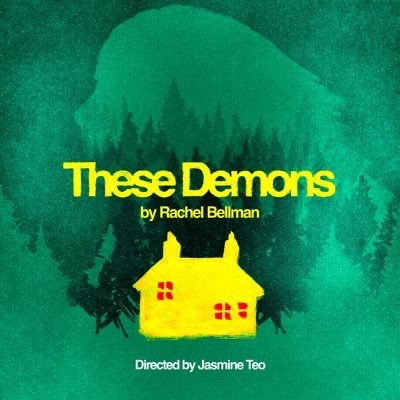
Tuesday, 3rd October 2023 at Theatre503, London
⭐️⭐️⭐️⭐️
Reviewer: Emma Dorfman
Caution: a few spoilers ahead…
These Demons is one of those few plays I had genuine excitement and anticipation about. I can’t believe I’m even writing these words, but it isn’t that often that I get to see the work of a Jewish playwright onstage. And there are even fewer instances in which I get to see the work of a female Jewish playwright. And how many times have I see a Jewish female playwright bring a horror-comedy to the stage? Zero.
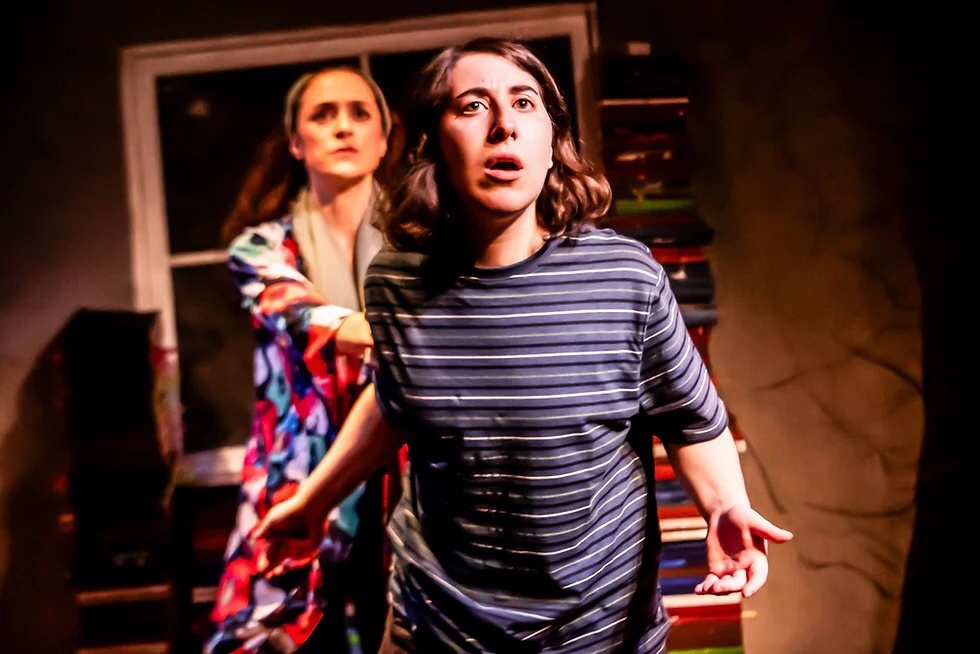
The spooky scene is set by designer Sophie Firth: a creaky cottage in rural England piled with much-loved books, filled with endless post-it notes and annotations. The silhouetted backdrop, when not backlit, is surrounded by dark, prickly branches that further emphasize the total darkness of the surrounding woods. At lights up, we meet Leah (Olivia Marcus), furiously scribbling notes and pasting them to the wall. It’s nonsense at this point, but when her sister Danielle (Liv Andrusier) arrives to confront Leah, take her back home, and put her back in the school she’s been bunking off, more is revealed.
We are then introduced to Aunt Mirah (Ann Marcuson): a wonderfully kooky, witchy author whose life’s work centres around Jewish mysticism and demonology. She is the one Leah has been bunking school to spend time with, as Mirah shares with her the steps to achieve a 16th-century Jewish exorcism. Here, we see one of the very first times the narrative flits seamlessly between past and present. It would typically be difficult to achieve the liminality of such scenes in a space as small as Theatre 503, but director Jasmine Teo has handled it brilliantly and clearly with a few small, yet effective, movement and lighting motifs.
When in Mirah’s world, we encounter some bits of Kabbalah, or, Jewish mysticism. It seems that Mirah has her own thoughts on the mysticism espoused in the Jewish tradition and what this might say about Jewish demons. And Leah says what we’re all thinking: ‘Jews don’t do exorcisms’.
At this point, and throughout the piece, it’s very clear that Mirah’s elaboration on the mystics is simply just that. And while it’s not based in any inherent truth or reality, when she declares, ‘Demons can be created by our deeds’, this notion will strike a cord with anyone familiar with the basics of Jewish ethics. The idea that our deeds can change outcomes is very much an extension of ‘Tikkun Olam’, or ‘healing the world’. In Mirah’s world, this is turned on its head to remind us that it’s also possible to do the opposite.
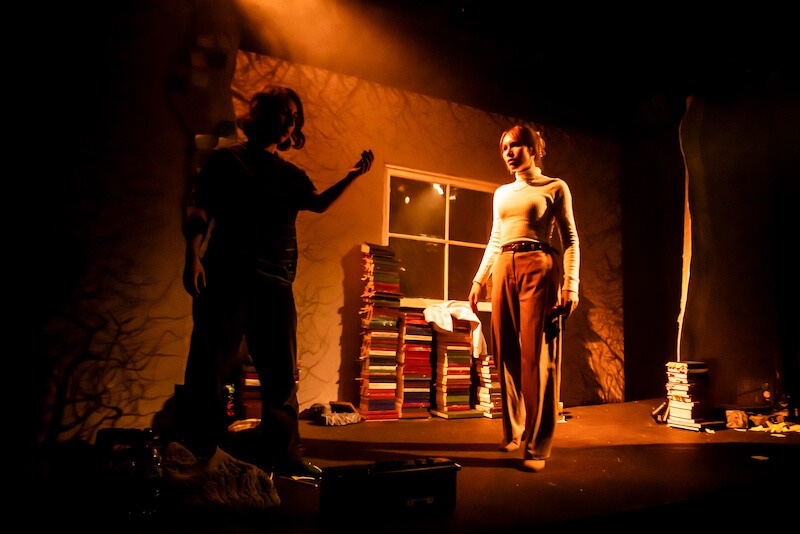
One of the characters that is symbolic of this comes in the form of a young village boy, who is ultimately the reason Aunt Mirah is not in the room with Danielle and Leah, as he has been terrorizing the premises. He writes, ‘Fuck off, you Jewish witch’ in the dirt of Mirah’s rock garden, and Leah feels an obligation to protect her aunt.
When Leah finally has the opportunity to confront the village boy, we are pushed into a lyrical, surreal moment in the woods. Backlit and standing stoically in the darkness, Mirah delivers more provocations sent down by the Jewish mystics about the mazzikim, the demons. Throughout, Mirah slinks and saunters across the space, urging us to reconsider reality and bringing genuine horror through simple, calculated movement (kudos to movement director Laura Wohlwend here) As Leah struggles with the boy in the woods, she also struggles with Mirah, now a booming voice in her head.
She finally finds her way back to the cottage, and to Danielle, after a brief scuffle with the boy. It’s here that Leah considers that maybe the boy is not one of the mazzikim. Maybe he is just a boy, and that’s even scarier.
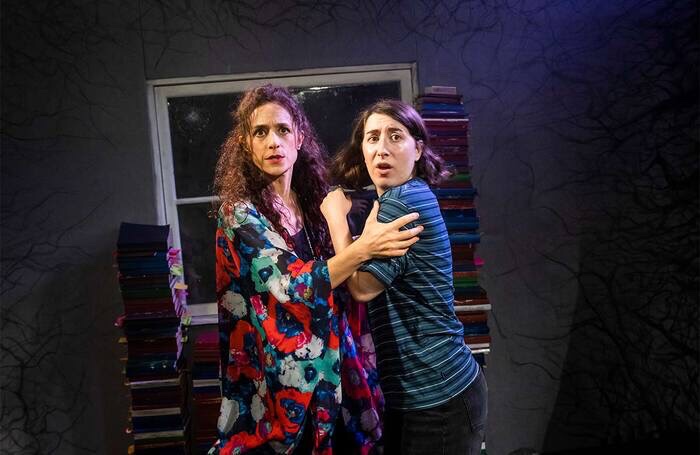
A few loose ends are made evident at this point. For one, there’s Leah and Danielle’s absent mother. Leah is now convinced that it was her deeds, her actions, that drove her mother away. After all, it wasn’t too long after her Bat Mitzvah. But the horrible deeds that Leah supposedly did to drive her mother away haven’t yet been fully teased out, if we are to believe that demons can be created by one’s actions. A single feather falls from above every time her mother is mentioned, and while it is clear that the non-presence of her mother still haunts her, it isn’t yet clear why it needs to be a white feather (which is pretty striking, symbolic potential).
Nonetheless, Rachel Bellman has achieved something here that not even many mid-career writers can do: a compelling, deeply personal and deeply researched tale that confounds notions of ‘good’ and ‘evil’. And, it argues, that grey area is the scariest part of all.
These Demons is at Theatre503, London until 14th October 2023 – more information and tickets can be found here.
 Always Time For Theatre
Leave a comment