
Thursday, 14th September 2023 at Park Theatre, London.
⭐️⭐️⭐️⭐️
Reviewer: Emma Dorfman
*Spoilers ahead*
‘Italians really love their absurdism, don’t they?’, the woman sitting to my left murmured to me following the cast’s curtain call. Absurdism? But this is real life!
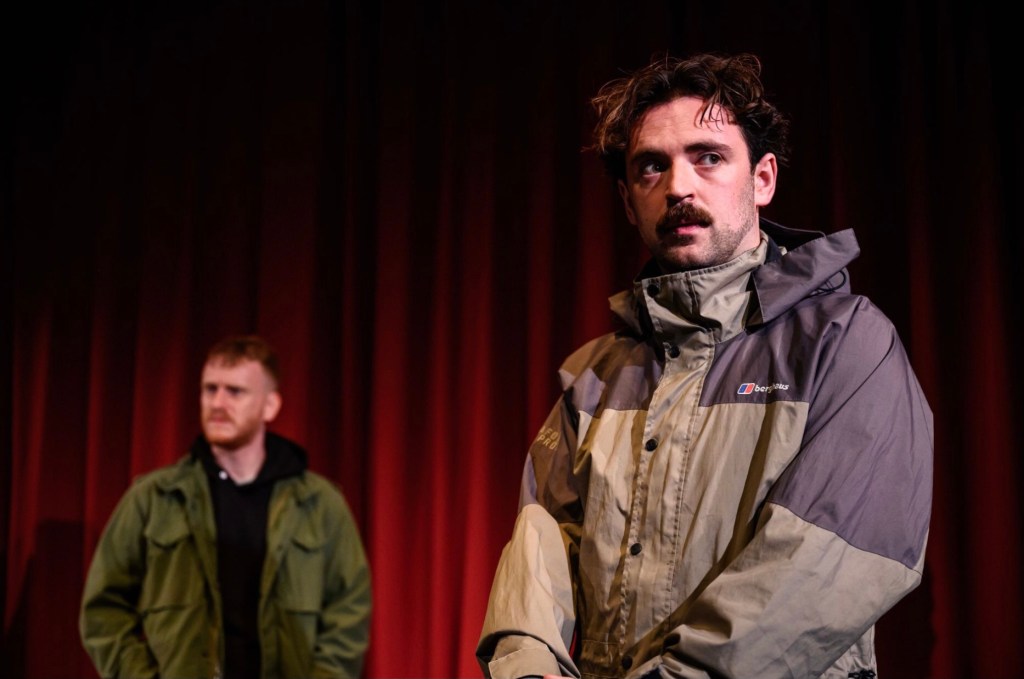
Emanuele Aldrovandi’s Sorry We Didn’t Die at Sea certainly has flavours of works such as Luigi Pirandello’s Six Characters in Search of an Author and Jean-Paul Satre’s No Exit: the plot has elements both linear and non-linear, some dominating, metatheatrical motifs, and its characters are posed as nameless, quasi-archetypes. And, I would venture to say, that what was once ‘absurdist’ has now become a simple facet of every day life, as we all continue to live in that liminal space between media and ‘real life’.
Indeed, when I was first exposed to this piece, I couldn’t help but turn to media. Three unknown people, with material possessions ranging from the clothes on their back to a full-on, Samsonite travel case, have decided to flee Europe. It’s no longer safe here. They cough up 1,000 quid now, and it will be another 1,000 when they get to their final, unknown destination. You can’t help but think of the post-Brexit discourse and subsequent immigration crisis that has been confounded both by this event and others in Africa and the Middle East. But, oddly enough, all I can think about is the stories in the media. I can’t actually think of any actual people I know who have fled from a similar situation to the one that The Stocky One (Marco Young), The Beautiful One (Yasmine Haller) and The Tall One (Will Bishop) find themselves in.

The piece itself frequently tests our notions of what is true and what is untrue: is that hair brush in The Beautiful One’s pocket really her grandmother’s? And did she used to sing that song while brushing her hair? Is The Stocky One really a millionaire with a successful business in Venezuela, and will he actually have £1,800 waiting at the port for The Tall One when they land? No one can be trusted, and the rules of this world are made crystal clear: there are no rules.
The Burly One (mesmerizingly played by Felix Garcia Guyer) will frequently come on to deliver some ‘truths’ to the audience. These are delivered through a handheld mic as if he were the emcee of the main event. To top it all off, you have the standard, oh-so-theatrical red curtain immediately behind him. It blocks the view of the stage from all three sides of the audience, acting as the very ISO containers The Burly One describes in one of his very first bits.
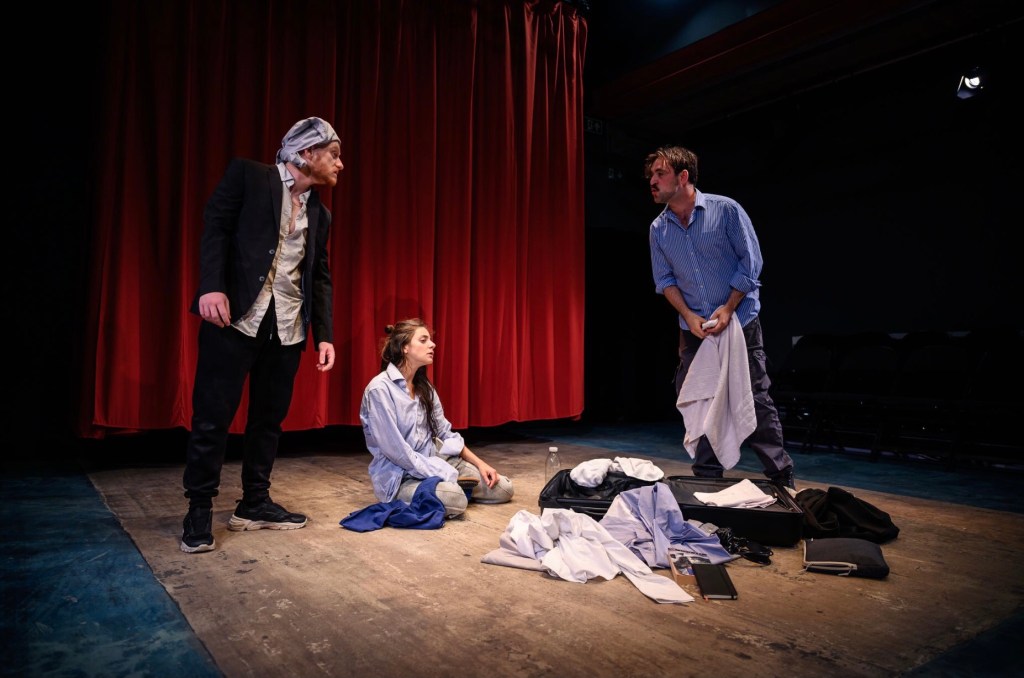
The curtain flits back and forth between those scenes that exponentially shift the narrative’s action, offering up a great device for sudden reveals. Alys Whitehead does the job, as always. With this curtain/ISO container as his backdrop, The Burly One delivers some verbatim material every so often: what starts out as info-tainment- or, something akin to a 1950s training video- it doesn’t take long to devolve into straight-forward, Wikipedia page recitations. As the speeches evolve, The Burly One’s function evolves as well, creating something almost reminiscent of the Emcee in Kander and Ebb’s ‘Cabaret’.
The migrants’ plan doesn’t pan out exactly as they thought, and after they find themselves shipwrecked, and after a bit more time after that, The Burly One finds them adrift in the middle of the ocean. They have reached the point of hunger where they have no choice but cannibalism, but which one of them deserves to die? Herein lies the central question of the piece: who deserves to survive? The character’s origins, their characteristics, what is true and what isn’t true, are all very difficult to know for sure. But should these matter when it comes to questions of life and death? Should privilege- whether that be in terms of race, class, origin, etc.- determine whether or not someone deserves to die?
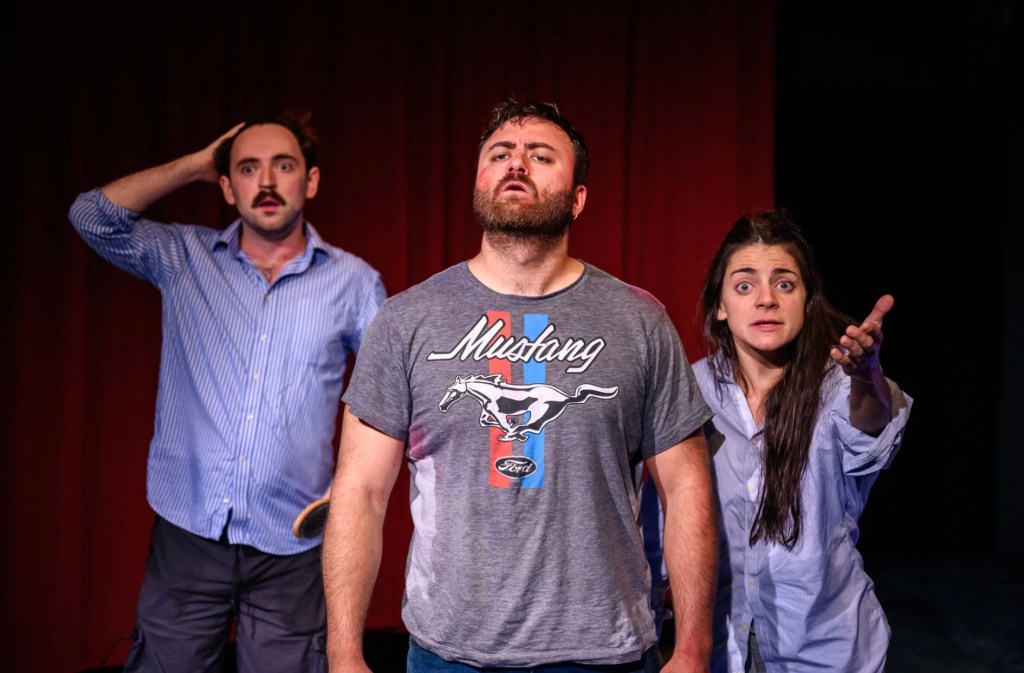
After The Stocky One is killed by The Burly One, The Burly One exclaims darkly, ‘Rather him than me, huh’? And, as much as I hate to be the bearer of cliches, but this *ahem* Brechtian device allows us to recognise our own responses to dark, intense news media. This is how we are able to cope with knowing nearly every single tragedy around us, thanks to a 24 hour news cycle.
The team behind Sorry We Didn’t Die at Sea certainly knew what they were doing when they chose to premiere in the United Kingdom, which has been no stranger to anti-immigrant vitriol in recent years. But the real feathers that have been ruffled here, according to my reviewer brethren, is the very form and shape the piece decides to take. It distances itself from the really tough, dark stuff. It laughs at the things it shouldn’t laugh at, and it makes light of things that really shouldn’t be made light of. But… don’t we all?
Sorry We Didn’t Die at Sea is at Park Theatre, London until 30th September 2023 – more information and tickets can be found here.
 Always Time For Theatre
Leave a comment